

US kills Iran general Qassem Suleimani in strike ordered by Trump
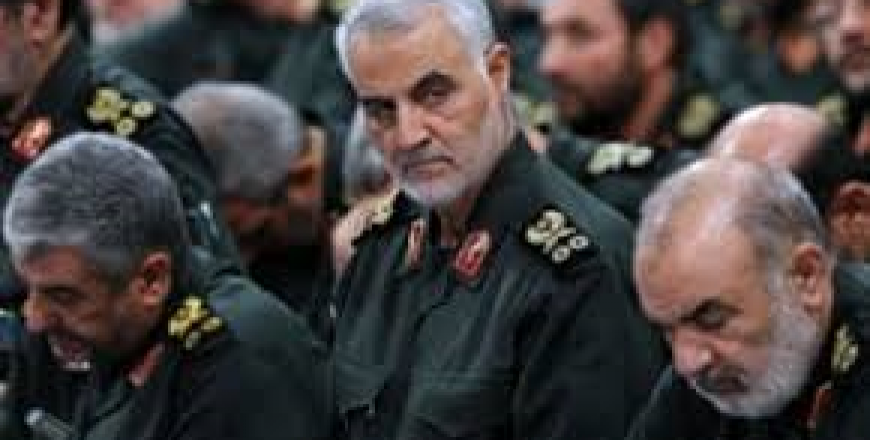
Iranian general Qassem Suleimani killed today in Baghdad drone strike ordered by the US president, Donald Trump.
Suleimani’s death is widely being seen as a dramatic escalation of the continued struggle between Washington and Tehran for influence across the region. The general, who ran Iranian military operations in Iraq and Syria, was hit while being driven from Baghdad airport by local allies from the Popular Mobilisation Units (PMU).
General Suleimani was actively developing plans to attack American diplomats and service members in Iraq and throughout the region,” a Pentagon statement said. “This strike was aimed at deterring future Iranian attack plans. The United States will continue to take all necessary action to protect our people and our interests wherever they are around the world.”
Minutes before the statement Trump tweeted a US flag without comment. Later, the White House put out a statement saying the strike was a “decisive defensive action” carried out “at the direction of the president”.
Iran’s supreme leader, Ali Khamenei, ordered three days of mourning and vowed that the US would face “severe revenge” for the killing.
Minutes before the White House released its statement, Trump tweeted a US flag without comment.
The United States embassy in Baghdad has called on all it citizens to depart Iraq immediately on Friday. The order follows the US airstrike killing Iranian Quds Force leader Qassem Soleimani and Iraqi militia commander Abu Mahdi al-Muhandis in an air strike.
“Due to heightened tensions in Iraq and the region, the US embassy urges American citizens to heed the January 2020 travel advisory and depart Iraq immediately. US citizens should depart via airline while possible, and failing that, to other countries via land,” it said in a statement.
The Iranian foreign minister, Mohammad Javad Zarif, released the following statement on Twitter: The US' act of international terrorism, targeting & assassinating General Soleimani—THE most effective force fighting Daesh (ISIS), Al Nusrah, Al Qaeda et al—is extremely dangerous & a foolish escalation. The US bears responsibility for all consequences of its rogue adventurism.
Iraq will hold an emergency parliament session on Saturday to discuss the US airstrike in Baghdad that killed Iran’s top military commander and Iraqi officials, Reuters reports. Iraq’s deputy parliament speaker, Hassan al-Kaabi, said it was time to put an end to US recklessness and arrogance, adding that Saturday’s session would be dedicated to taking “decisive decisions that put an end to US presence inside Iraq”. The outgoing prime minister Adel Abdul-Mahdi had called for an emergency session, saying the US presence in Iraq is limited to training forces to fight terrorism. He described the attack that killed Qassem Suleimani and the Iraqi officials as a “violation” of conditions for the US troop presence.
China has called for all sides to exercise calm and restraint. Foreign ministry spokesman Geng Shuang called for peace and stability in the Middle East as well as respect for Iraq’s independence and territorial integrity. The spokesman said China had always opposed the use of force in international relations and warned against the further escalation of tensions.
The British foreign secretary, Dominic Raab, has urged “all parties to de-escalate” after the US airstrike that killed the Iranian general Qassem Suleimani. In a written statement, Raab said: “We have always recognised the aggressive threat posed by the Iranian Quds force led by Qassem Suleimani. Following his death, we urge all parties to de-escalate. Further conflict is in none of our interests.” Keir Starmer, the current frontrunner to win the Labour leadership, tweeted that the incident is “an extremely serious situation” and called for all sides to de-escalate tensions.
Oil prices soared early on Friday morning after the US airstrike that killed the top Iranian commander, increasing tensions between the two powers. Oil prices rose over $2 a barrel, while gold and other safe-haven assets jumped on Friday, Reuters reported, adding “traders were clearly spooked” by Qassem Suleimani’s death.
Foreign oil companies were evacuating dozens of employees with US citizenship from Basra in Iraq, citing company sources.
Israeli’s prime minister, Benjamin Netanyahu, has cut short a visit to Greece following the killing. The prime minister’s office said he was returning to Israel early “to follow developments” but did not say when. Israel, which has fought an increasingly overt war against Iranian forces in neighbouring Syria, is preparing itself for a potential military retaliation from Tehran to the US attack. Netanyahu was in Athens following the deal signed by Greece, Cyprus and Israel on Thursday to build a 1,900km (1,180-mile) subsea pipeline to carry natural gas from the eastern Mediterranean’s rapidly developing gas fields to Europe.
Former Middle East minister Alistair Burt has described the US airstrike that killed Iran’s Gen Qaseem Suleimani as “extremely serious” and warned it could spark a huge escalation. He told BBC Radio 4’s Today programme: “There is no agreement as to a base of the confrontations in the region. There is a completely different narrative put forward by the Iranians for what is happening in the region to that which is put forward by the United States and others – there is no meeting between to two.” Burt added that the airstrike could cause “a huge potential escalation” of the conflict, of which “the consequences are unknown”. He said that it was “very important now to concentrate on what happens next, and for everybody involved diplomatically to do everything they can to try and defuse the situation”. He added: “It’s extremely serious.”
Tom Fletcher, a former UK ambassador to Lebanon, has said Qassem Suleimani was a “much more powerful figure than Osama bin Laden or Baghdadi, where at the moment of their own deaths their power was in decline. His [power] was growing, as it has been really since the US invasion of Iraq.” He added that it was “hard to overstate the potential impact of this moment”. Fletcher said Iran had been “goading Washington, goading Donald Trump”, adding: “And of course, we don’t just have erratic leaders at the moment in Tehran, we have an erratic leader in Washington as well.”
The leader of the Revolutionary Guards’ Quds force was a bearded icon of the Islamic Republic, arguably its second most powerful figure after the supreme leader, Ayatollah Ali Khamenei. Killing him was a blunt act of war against a substantial regional power. Its half-million-strong armed services are the most potent military force the US has faced since confronting the Chinese People’s Volunteer Army more than 60 years ago in Korea.
Qassem Suleimani had become well known among Iranians in past years and was sometimes discussed as a future president. Yet the leader of the Revolutionary Guards’ Quds force was still a relatively obscure figure outside a region that he may have done more than anyone to reshape.
“He was more important than the president, spoke to all factions in Iran, had a direct line to the supreme leader and was in charge of Iran’s regional policy,” said Dina Esfandiary, a fellow at the Century Foundation think tank. “It doesn’t get more important and influential than that.”
The shadowy Quds force are tasked with spreading Iran’s influence abroad and, in the past two decades, Suleimani, 62, had extraordinary success doing so. In the chaos and death that followed the 2003 US-led invasion of Iraq and the 2011 Syrian revolution, Suleimani saw opportunity, pouring in men and money to build a crescent of pro-Iran forces stretching across the region from Lebanon in the west to Yemen in the south.