

Turkey says no ceasefire violations in Syria's Idlib
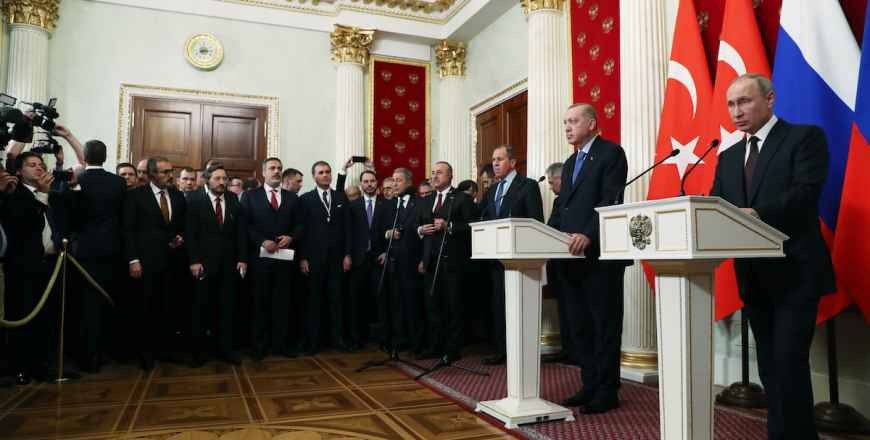
Turkey's defence minister says there have been no violations of a ceasefire deal in Syria's war-battered Idlib province, where residents and opposition forces described a lull in air raids that have pounded the country's last rebel-held enclave.
Russia and Turkey struck the agreement on Thursday evening, after six hours of talks in Moscow, to contain a conflict that has displaced nearly a million people in three months in northwest Syria.
"We will continue to be a deterrent force to prevent any violation to the ceasefire. None occurred since ceasefire entered into force," Turkish Defence Minister Hulusi Akar said on Saturday.
He added that Ankara would use self-defence rights if its forces or bases in the region were to come under attack.
NATO-member Turkey and Russia back opposing sides in Syria's nine-year-old war - Moscow supports President Bashar al-Assad and Ankara backs some opposition groups - while the two sides edged closer to direct confrontation in recent weeks.
The deal reached in Moscow during talks between Turkish President Recep Tayyip Erdogan and his Russian counterpart, Vladimir Putin, also establishes a security corridor on each side of Idlib's key east-west M4 highway, along which joint Russian-Turkish patrols will begin on March 15.
The corridor stretches 6km (3.7 miles) to the north and 6km to the south of the M4 - effectively advancing Russia's presence further north into Idlib.
Akar on Saturday said Turkey had started to work on the procedures and principles of the safety corridor around the strategic road, adding that a Russian military delegation will visit Ankara next week to discuss steps to take.
Several previous deals to end the fighting in Idlib have collapsed. Analysts and residents said they feared the latest ceasefire would also fizzle out as it did not address the humanitarian crisis or air protection in any detail.
"This deal isn't designed to last. Rather, it is designed to fail, and I am afraid, in the not-too-distant future," said Galip Dalay, IPC-Mercator fellow at the German Institute for International and Security Affairs.