

Joint statement by the Presidents of the Baltic States on the end of the Second World War in Europe
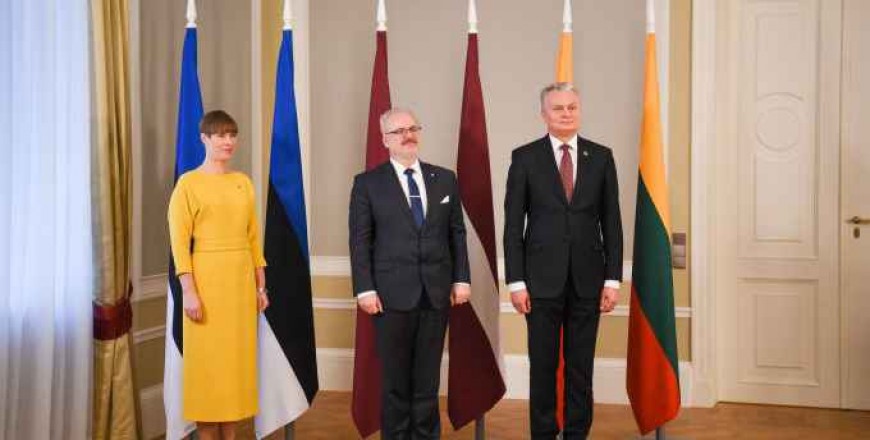
On the eve of the 75th anniversary of the end of World War II, the Presidents of the Baltic States Gitanas Nausėda, Egils Levits and Kersti Kaljulaid signed a joint statement where they paid tribute to all victims of World War II and urged the world leaders to reject efforts to rewrite history.
The Presidents stated that the end of World War II did not mark freedom to the nations of Central and Eastern Europe, instead, one totalitarian regime was replaced by another. For the Baltic States it meant Soviet occupation and annexation. “Two ruthless dictators – Hitler and Stalin – had divided Europe into their spheres of influence through secret protocols of the Molotov-Ribbentrop Pact between the Soviet Union and Nazi Germany. The central and eastern part of the continent remained under the rule of communist regimes for almost half a century. The Soviet Union used overwhelming military force, indiscriminate repression, mass deportations and total ideological control to subjugate the Baltic nations,” the Presidents said in the statement and emphasized that World War II in the Baltic States ended only after the withdrawal of the Russian army when national independence was restored in 1990-1991.
The Presidents highlighted that the Soviet occupation and its lessons were still a bleeding wound that urged the Baltic States to fight for historic truth and justice. The three Baltic leaders stressed that some countries falsified historical events of World War II and those that followed in the aftermath and efforts were made to question the very foundation of the contemporary international rules-based order.
“We firmly reject the concept of spheres of influence and insist on equality of all nations. The imperative of international security requires continuous adherence to international law and agreed norms, as well as unconditional respect for the territorial integrity of all sovereign states and their right to choose their own security arrangements and enter into unions and alliances. We reiterate that NATO remains the foundation of the collective defense of our countries and the transatlantic link is of vital importance for the future security and stability of Europe,” the Presidents said in the statement.
The Presidents expressed gratitude to more than 60 countries which had not recognized the Soviet occupation of the Baltic States and supported their struggle for independence after the end of World War II.
An official appeal of the Baltic Presidents is addressed to all the leaders of the world to establish the principles of historical memory related to the responsibilities and assessments of World War II and the post-war period. The 75th anniversary of the end of World War II is marked on May 8.
The Joint Statement (full text):
“We, the Presidents of Estonia, Latvia and Lithuania, commemorate the 75th anniversary of the end of World War II in Europe, honour the sacrifice of all victims and the Allied soldiers who defeated the Nazi regime on 8 May 1945, thus liberating many European countries from occupation and ending the horrors of the Holocaust.
In the aftermath of the war, the United Nations were formed in recognition of the need for a rules-based international order and multilateral cooperation to protect peace, security and common values. Western Europe began to implement the vision of a Europe whole and free, based on peace, democracy, rule of law and human rights. The Council of Europe, NATO and the Treaty of Rome were the founding stones for a new Europe.
However, the end of World War II does not mark freedom to the nations of Central and Eastern Europe. Instead, one totalitarian regime was replaced by another when the Baltic states were brutally incorporated into the Soviet Union.
Two ruthless dictators – Hitler and Stalin – had divided Europe into their spheres of influence through secret protocols of the Molotov-Ribbentrop Pact between the Soviet Union and Nazi Germany. Following the start of World War II on 1 September 1939, the Soviet Union occupied and annexed Estonia, Latvia and Lithuania as a consequence of this agreement and the Soviet-German Boundary and Friendship Treaty.
The central and eastern part of the continent remained under the rule of communist regimes for almost half a century. The Soviet Union used overwhelming military force, indiscriminate repression, mass deportations and total ideological control to subjugate the Baltic nations.
The Soviet occupation continued until the collapse of the Soviet Union, thanks to the peaceful and determined efforts of our citizens in our territories and throughout the world, national independence of Estonia, Latvia and Lithuania was restored in 19901991. A few years later, the Russian army was withdrawn from our states.
We pay tribute to those more than 60 Western countries which had not recognized the Soviet occupation of our states de jure. The Welles Declaration by the US Department of State started the policy of non-recognition on 23 July 1940.
Today, our nations are an integral part of the European Union and NATO. However, one cannot forget the tragic lessons of the past. We underline the importance of truth and justice. Misrepresentation of historical events that led to World War II and the division of Europe in the aftermath of the war constitute a regrettable effort to falsify history and question the very foundation of the contemporary international rulesbased order.
We firmly reject the concept of spheres of influence and insist on equality of all nations. The imperative of international security requires continuous adherence to international law and agreed norms, as well as unconditional respect for the territorial integrity of all sovereign states and their right to choose their own security arrangements and enter into unions and alliances. We reiterate that NATO remains the foundation of the collective defence of our countries and the Transatlantic link is of vital importance for the future security and stability of Europe.
We believe that the Western democratic values and unity will ensure the future of the Baltic states and every European nation”.