

Erdogan Reiterates Offer To Mediate In Ukraine-Russia Standoff
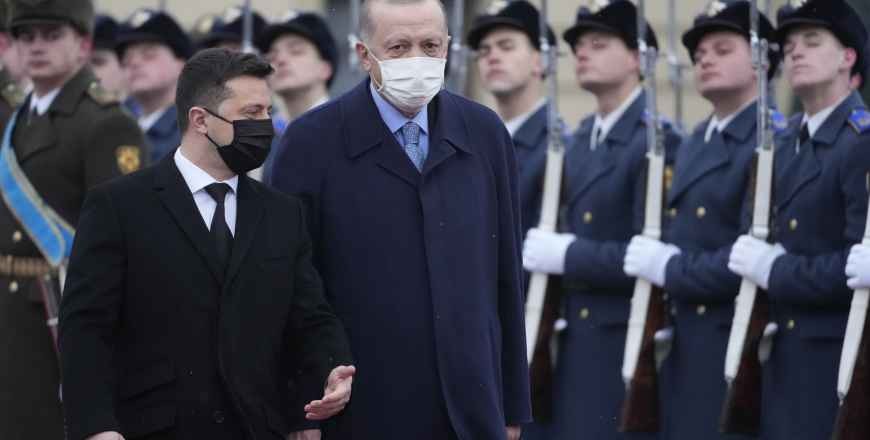
According to RFE/RL, Ukrainian President Volodymyr Zelenskiy has welcomed an offer from visiting Turkish President Recep Tayyip Erdogan to mediate in Kyiv's standoff with Moscow.
Speaking during a visit to Kyiv on February 3, Erdogan said Turkey was "prepared to undertake its part in order to end the crisis between two friendly nations that are its neighbors in the Black Sea.”
Erdogan, who has close ties with Russian President Vladimir Putin, said he would be “happy to host a summit at the level of leaders in Turkey or talks at the technical level."
Zelenskiy thanked Erdogan for his initiative and welcomed Turkey’s plans to expand its diplomatic missions in Ukraine and a deal enabling Ukrainian factories to produce Turkish drones.
Turkey and Ukraine signed a series of agreements during the meeting including a free trade deal that Kyiv says will boost bilateral annual commerce to about $10 billion over five years from $7 billion now.
Erdogan is the latest leader of a NATO country to visit Kyiv after the premiers of the Netherlands, Poland, and Britain amid heightened diplomacy to ease tensions over Russia’s military buildup near its border with Ukraine.
French President Emmanuel Macron spoke by phone separately with Putin and Zelenskiy on February 3 to try defuse tensions.
The calls were part of Macron’s efforts to “pursue dialogue to identify elements that could lead to de-escalation,” according to his office. They discussed the efforts to resolve the conflict in eastern Ukraine and “conditions for strategic balance in Europe, which should allow for the reduction of risks on the ground and guarantee security on the continent.”
Earlier on February 3, NATO Secretary-General Jens Stoltenberg accused Moscow of amassing some 30,000 combat troops and modern weapons in Belarus ahead of planned joint military drills later this month. Stoltenberg called Russia's deployment the biggest to Belarus since the end of the Cold War.
Stoltenberg's announcement came after Washington said it would send thousands of troops to Europe to bolster NATO allies amid a continued standoff prompted by a massive Russian troop buildup near the Ukrainian border that the West suspects could be the prelude to an invasion.
The Kremlin said on February 3 that the U.S. move was further ramping up the crisis instead of de-escalating it.
Russia and Belarus have announced joint military drills to take place from February 10 to 20.
Stoltenberg, speaking to reporters in Brussels on February 3, said the Russian deployment to Belarus included Spetsnaz special operations forces, SU-35 fighter jets, dual-capable Iskander missiles, and S-400 air-defense systems.