

Putin Hosts Trilateral Meeting With Armenia, Azerbaijan Leaders
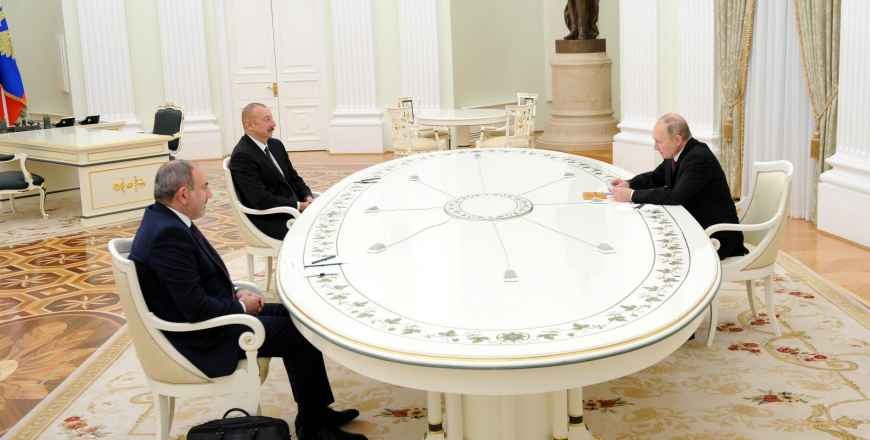
According to RFE/RL, Russian President Vladimir Putin has hosted a trilateral meeting in Moscow with the leaders of Armenia and Azerbaijan, nearly two months after a Russia-brokered cease-fire agreement ended six weeks of fierce fighting over the breakaway region of Nagorno-Karabakh.
Following the talks, Putin, Azerbaijani President Ilham Aliyev, and Armenian Prime Minister Nikol Pashinian issued a joint statement on the Kremlin website announcing the creation of a trilateral working group to oversee the "unblocking of all economic and transport links" in the region.
The group will be jointly chaired by deputy prime ministers from the three countries and will hold its first meeting before January 30, the statement said.
Aliyev called Putin's invitation for the trilateral meeting "very useful and productive," saying afterward that the Nagorno-Karabakh conflict "remained in the past."
However, Pashinian said the conflict was still not resolved, insisting that key issues surrounding the conflict were in suspension and needed to be resolved immediately.
"Unfortunately, this conflict is still not settled," he told journalists after talks that lasted nearly four hours.
Putin at the start of the meeting thanked the two leaders for their cooperation with Russia's mediation efforts aimed at "stopping the bloodshed, stabilizing the situation, and achieving a sustainable cease-fire."
Under a cease-fire agreement reached on November 9, a chunk of Nagorno-Karabakh and all seven districts around it were placed under Azerbaijani administration after almost 30 years of control by ethnic Armenians. More than 4,700 people were killed in the flare-up of violence.
Putin said that the truce had been successfully implemented, laying the foundation for a fair settlement of the decades-long conflict.
Around 2,000 Russian peacekeepers are deployed along frontline areas and to protect a land link connecting Nagorno-Karabakh with Armenia. They are also engaged in demining, returning displaced Armenians, and rebuilding damaged infrastructure.
Many details of the agreement remain unclear, including the final political status of Nagorno-Karabakh, the exact contours of the border separating the two sides along a still militarized front line, and economic issues.
Pashinian said several issues remained unresolved, and that the meeting did not render a solution to the "most sensitive and painful question" of prisoners of war.