

Turkey-Syria-Russia tensions escalate: updates
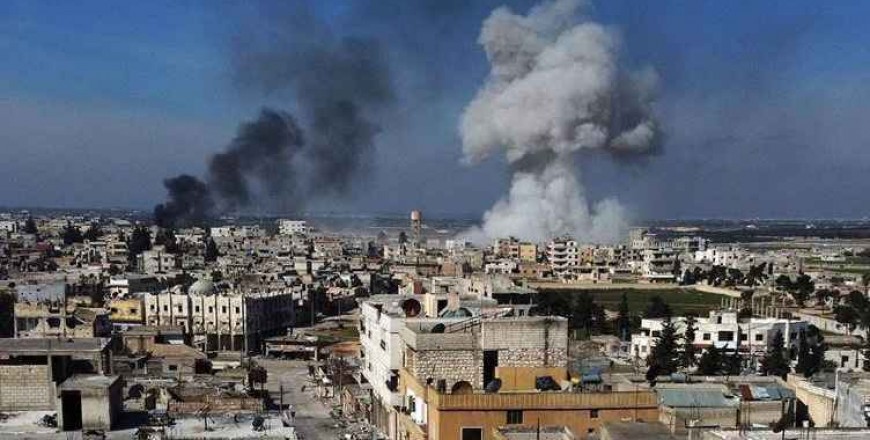
29 NATO Allies met in the North Atlantic Council on Friday (28 February 2020), following a request by Turkey to hold consultations under Article 4 of the Washington Treaty on the situation in Syria. Under Article 4 of the Treaty, any Ally can request consultations whenever, in the opinion of any of them, their territorial integrity, political independence or security is threatened. Allies offered their deepest condolences for the death of Turkish soldiers near Idlib. They also condemned the indiscriminate air strikes by the Syrian regime and its backer Russia in Idlib province, and called on them to stop their offensive, to respect international law and to back UN efforts for a peaceful solution. NATO Secretary General Jens Stoltenberg stressed that NATO stands in strong solidarity with Turkey and will continue to support Turkey with a range of measures, including augmenting its air defences.
Turkey's president spoke via telephone with his French counterpart about the recent situation in Idlib, northwestern Syria, the Turkish Communications Directorate announced on March 1. Recep Tayyip Erdoğan and Emmanuel Macron discussed bilateral relations, refugee crisis and regional issues, the directorate said. Stressing that Turkey will retaliate against Assad regime's attacks, Erdoğan said he expected NATO's concrete and clear solidarity during phone call. He underlined that the humanitarian crisis in the region will be deepened as the regime continues its attacks. Noting the refugee influx started to put pressure on Turkey's European borders, Erdoğan said he expected from Europe and France to offer concrete solutions and support for displaced people. Macron urged Russia to immediately end attacks in Idlib.
Russian President Vladimir Putin on March 1 discussed the situation in Syria in separate phone talks with his Iranian counterpart Hasan Rouhani and France's Emmanuel Macron. Putin and Rouhani discussed in detail the rising tensions in Syria's northwestern province of Idlib, the Kremlin said in a statement. "Detailed consideration was given to the developments in Syria in the context of increasing tensions in the Idlib de-escalation zone. The two leaders expressed their shared opinion that the full implementation of the Astana format agreements is needed,” it said.
The recent developments in Syria were also the main topic of the phone conversation between Putin and Macron, according to another statement by the Kremlin. "Vladimir Putin told the President of France about steps taken to fight terrorists in Syria's northwest. In addition, the humanitarian situation in that area was discussed. The President of Russia said that all current aspects of a Syrian settlement are to be substantively discussed in Moscow at the Russia-Turkey summit […] in the coming days," the statement said.
Thousands of migrants may be in no man’s land between Turkey and Greece after Ankara opened its western borders, sparking chaotic scenes as Greek troops attempted to prevent refugees from entering Europe en masse. Turkey’s president, Recep Tayyip Erdoğan, claimed 18,000 migrants had crossed the border, without immediately providing supporting evidence, but many appear to have been repelled by Greek border patrols firing teargas and stun grenades. Erdoğan has long threatened to allow refugees and migrants transit into the EU, with which Turkey signed an accord in 2016 to stem westward migration in return for financial aid. He stressed the frontier would remain open. “We will not close these doors in the coming period and this will continue,” he said in Istanbul on Saturday. “Why? The European Union needs to keep its promises. We are not obliged to look after and feed so many refugees. If you’re honest, if you’re sincere, then you need to share.” Erdoğan complained that funds transferred to Turkey from the EU to support refugees were arriving too slowly, saying he had asked Angela Merkel, the German chancellor, to send them directly to his government. But the policy shift appears to be intended to force the EU and Nato to support Ankara’s new military campaign in the north-western province of Idlib, Syria’s last rebel stronghold, where thousands of Turkish soldiers are supporting opposition forces facing an onslaught from regime forces backed by Russian air power. Erdoğan said Turkey could not handle a new wave of migration, in an apparent reference to the growing humanitarian crisis in Idlib.The Idlib offensive has pushed almost a million displaced civilians toward the Syrian-Turkish border, and hundreds of thousands of Syrian civilians remain between advancing Syrian government forces backed by and rebel fighters supported by Turkey.
Greek authorities said 52 ships were patrolling the seas around Lesbos, along with other Aegean isles, in an apparent show of force to deter clandestine voyages. Greece has also bolstered its eastern land border, while Bulgaria has sent an extra 1,000 troops to its border with Turkey. A Greek government spokesperson, Stelios Petsas, said after an emergency meeting of ministers that security forces had repelled “more than 4,000 illegal entries”. Sixty-six people had been arrested after making their way through forest land into the country, none of whom were believed to hail from Idlib, according to Petsas.
The UN secretary general, António Guterres, called for an immediate ceasefire and said the risk of ever greater escalation was growing by the hour, with civilians paying the gravest price.